Ivy (Hedera helix)
Ivy is a common evergreen plant in the UK.
Due to its habitats of creeping up walls and trees it is one of our most recognisable plants.
There is some debate about the effect of ivy on tree health, it would be easy to believe that the apparent girdling and the extra competition for light would have a negative effect on tree vigour, However this is not always the case.
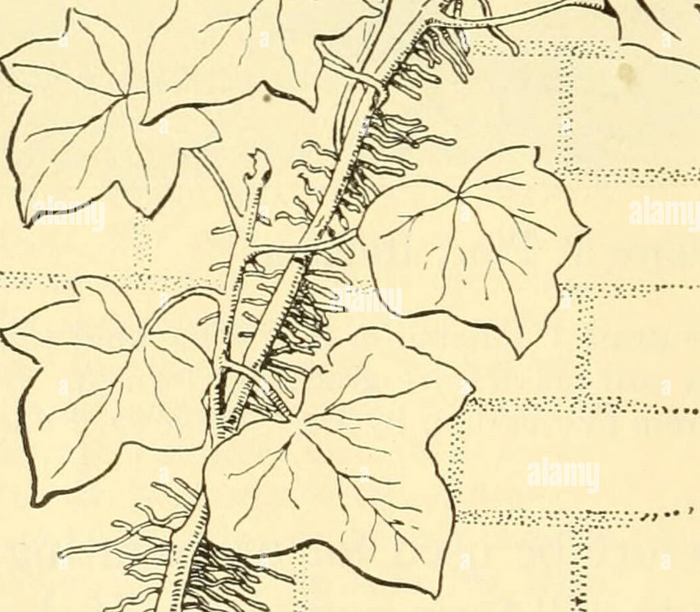
Rootings and ground cover.
The anchorage system of Ivy is not parasitic to the tree as some species such as Mistletoe (Viscum album). It is more akin to a very strong glue than an intrusive rooting system.
The attachment method is superficial to the tree as the Ivy provides enough material elasticity to allow a solid attachment to the bark without restriction on wood growth. Resulting in no girdling.
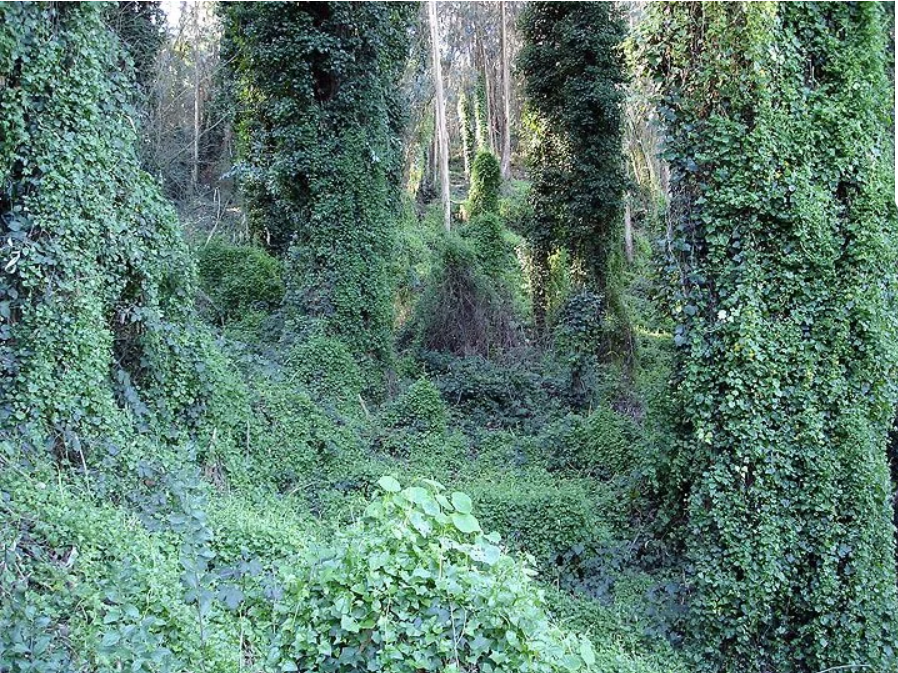
Ground Cover
Ivy in its ground form provides very good green cover in light restricted environments.
This provides a low maintenance cover in areas where very few other species would survive, These dark high humidity environments are a universe of mycorrhizal and microscopic life on what would otherwise likely be bare earth.
In a forest setting, Ivy is very conducive to natural regeneration, The low cover provided by the Ivy shelters young seedlings at their most tender. Competition between ivy and young trees is minimal, competition is mainly with grass or moss.

Foliage
Unlike the majority of our native trees, Ivy provides evergreen cover, Foliage in winter is a pleasant change from the usually barren canopies in the wintertime. The complex branching provides shelter and foliage year round for many of our small bird species such as Blackbirds, Thrushes, Starlings, Wrens, Tits and Robins. Ivy in canopies provides an essential winter refuge for species before they spread out into other spaces with the spring.
However, when trees turn to a state of decline a full secondary crown of ivy can provide a level of light competition that can significantly increase the rate of decline, during natural retrenchment this can be a cause for concern. Ivy around the central stem and within the crown is (species dependent) usually fine. When foliage of the host starts to become suppressed by the ivy it can cause phototropism on the host resulting in a wider spread canopy and a less dense photosynthetic mass, this is either positive or negative depending on management objectives.

Inspections
Ivy can conceal serious defects on trees at all stages, They prevent sounding, can be obscuring details and prevent probe access. A though inspection when deemed necessary requires significant Ivy removal, up to 90% with mature vines. This is often a complex task. Preliminary assessments can be made of trees hosting mature vines however they are likely to conclude a proper inspection would need management works prior